
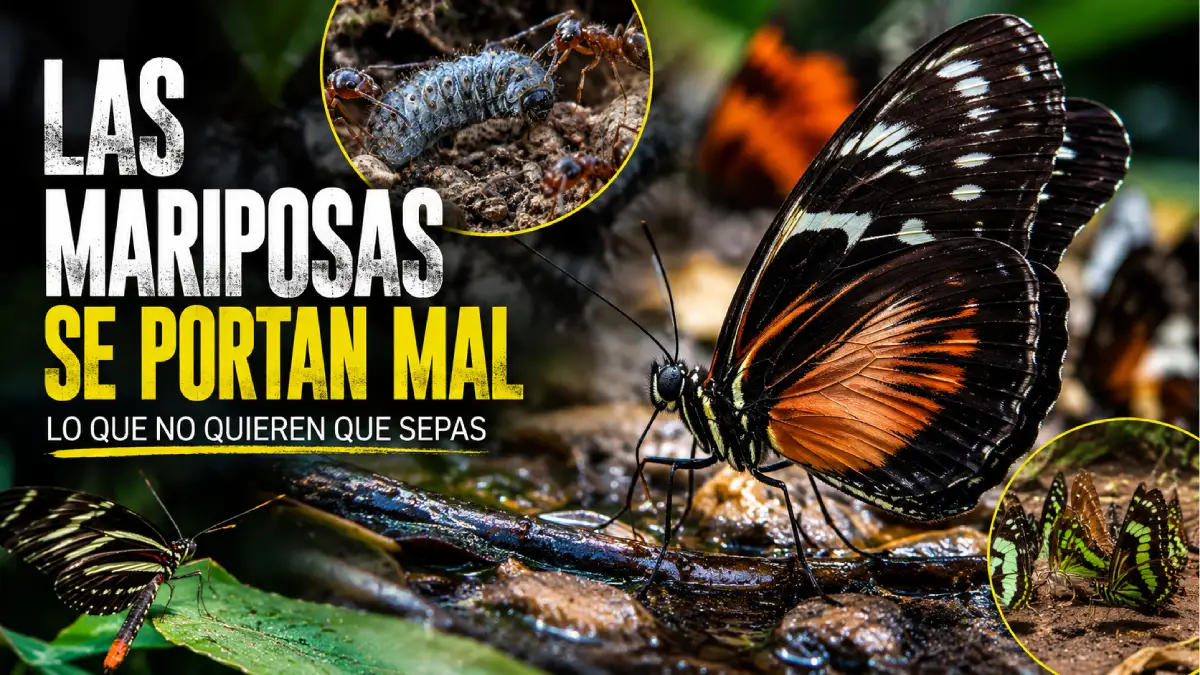
You might imagine butterflies as fluffy creatures in brightly coloured gardens with happy faces. Butterflies misbehave: what they don’t want you to know offers quite another view. We explore the less innocent world of this Pushout and other butterflies, who are not always such placid beings.
What makes a good subject because even these “easy to understand” categories are actually very complex –Butterflies: ‘beautiful pollinators’ – but actually feed on a complex mixture of substances, employ varied defense strategies, compete and are very interdependent with other organisms (this is a very good introduction to the subject, and if I didn’t know the answer already, I might think this and do some research).
This document aims to outline the article’s major concepts, to divide true biological activity from hyperbole and to incorporate biological considerations where relevant.
Table of Contents
Definition:
Las mariposas se portan mal: Lo que no quieren que sepas-an article written in Spanish published on Pussmoth in February 2024 covering unusual behavior of butterflies and caterpillars. An article discussing warning coloration, aggressive behavior, unconventional diets and caterpillar and ant symbiotic relationships, aiming at contrasting the normal perception of butterflies.
The title is purposefully click baity. Butterflies are not inherently “evil” but I just wanted to grab your attention with some behaviors that you may not expect from a butterflies perspective.
What Is the Pussmoth Article About?
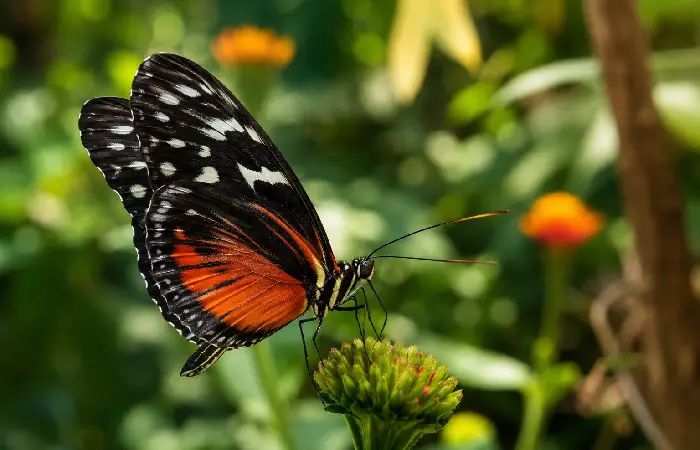
The article takes a deliberately dramatic approach to an otherwise scientific subject: butterfly behaviour.
Its central idea is simple:
Butterflies are more complicated than their attractive appearance suggests.
The article discusses several examples, including:
- Defensive or warning colours
- Unusual caterpillar behaviour
- Competition between adult butterflies
- Feeding on sources other than flower nectar
- Puddling behaviour
- Reproductive behaviour
- Relationships between caterpillars and ants
- Parasitic strategies used by some butterfly larvae
These subjects belong to several different areas of entomology, including ecology, animal behaviour and evolutionary biology.
The original article specifically mentions zebra longwing butterflies, emperor butterflies and Maculinea rebeli as examples of unusual behaviour.
Why Do Butterflies Have Such Unusual Behaviours?
A butterfly’s life is governed by survival and reproduction.
Humans may see a colourful insect moving between flowers, but the insect is responding to environmental pressures. It needs to find food, avoid predators, reproduce and, during its caterpillar stage, acquire enough energy to complete metamorphosis.
This produces behaviours that can appear strange to people.
For example, a butterfly may consume minerals from damp soil rather than simply feeding on nectar. A caterpillar may exploit another species for protection or food. An adult butterfly may compete aggressively with another individual over territory or resources.
None of these behaviours mean the insect is “evil”. They are evolutionary adaptations that can increase survival or reproductive success.
Key Topics Covered by Las mariposas se portan mal: Lo que no quieren que sepas
The Pussmoth article contains several distinct topic clusters.
| Topic | What It Explores | Why It Matters |
| Warning colours | Bright colours can communicate danger or unpalatability | Predator avoidance |
| Caterpillars | Larvae can behave very differently from adults | Shows the complexity of metamorphosis |
| Competition | Butterflies may compete for territory or resources | Supports mating and feeding opportunities |
| Unusual feeding | Some butterflies seek minerals and nutrients outside flowers | Helps explain puddling |
| Reproduction | Butterfly mating can involve intense competition | Important for natural selection |
| Ant relationships | Some caterpillars interact closely with ant colonies | Demonstrates specialised adaptation |
| Survival strategies | Different species use different ecological strategies | Explains butterfly diversity |
The original article connects these topics through the idea that attractive appearance does not tell us everything about an animal’s biology.
Warning Colours Are More Than Decoration
One of the article’s opening observations concerns butterfly colours.
Bright colours can be visually attractive to humans, but colouration in animals can have several biological functions. In some species, strong colours can serve as a warning to predators that an animal is toxic, distasteful or otherwise worth avoiding.
The zebra longwing, Heliconius charithonia, is used in the article as an example. The article also discusses unusual behaviour among its caterpillars.
It is important not to assume that every brightly coloured butterfly is poisonous. Butterfly colour patterns have multiple functions, including camouflage, mimicry, mate recognition and predator deterrence.
That distinction is important when reading sensational wildlife articles.
Unusual Feeding: Why Butterflies Visit Mud, Sap and Other Sources
One of the more interesting subjects in the article is mud-puddling.
People often associate butterflies with nectar-rich flowers. However, many butterflies also seek nutrients that flowers do not provide in sufficient quantities.
They may gather around:
- Wet soil
- Mud
- Mineral-rich puddles
- Animal droppings
- Fermenting plant material
- Carrion
- Sweat
- Other nutrient-rich sources
The Pussmoth article describes emperor butterflies gathering around fermented sap and other nutrient sources. It also discusses butterflies drinking from mud, sweat and other unusual sources.
This behaviour makes more sense when viewed from an ecological perspective. Nectar is primarily an energy source. Butterflies may also need minerals, salts and other nutrients.
Workflow: How Mud-Puddling Works
Suitable nutrient source appears
↓
Butterflies locate the source
↓
They land and extend the proboscis
↓
Liquid and dissolved nutrients are consumed
↓
Minerals and salts are absorbed
↓
Butterflies leave when the resource is depleted or disturbed
This is one reason a seemingly ordinary muddy patch can attract surprisingly large numbers of butterflies.
Do Butterflies Really Drink Animal Tears?
The article also refers to butterflies drinking turtle tears.
This behaviour is often described online because it looks extraordinary, but it should be understood as a specialised form of nutrient acquisition rather than an indication that butterflies depend on tears as their normal food.
Butterflies can seek salt and other minerals from unexpected sources. In suitable environmental conditions, fluids associated with animals can provide accessible dissolved nutrients.
The important lesson is that butterfly feeding behaviour is considerably broader than “butterflies eat nectar”.
Butterfly Competition Can Be Surprisingly Aggressive
Another section of Las mariposas se portan mal: Lo que no quieren que sepas describes a fight between two emperor butterflies.
The article recounts observations of butterflies competing around fermented sap, with the conflict becoming physically aggressive.
This is a useful reminder that butterflies are not simply passive creatures drifting between flowers.
Competition can occur when individuals want access to:
- Food resources
- Territory
- Mates
- Mineral-rich locations
- Suitable resting sites
The exact form of competition varies between species.
Expectations Management
It would be misleading to conclude that butterflies are generally aggressive insects.
Most encounters are not dramatic fights. The important point is that butterflies, like other animals, can compete when valuable resources are limited.
A single unusual observation should therefore be treated as an example of behaviour, not a description of every butterfly species.
The Darker Side of Butterfly Reproduction
The article’s most provocative section concerns reproductive behaviour involving pupae. It describes males attempting to mate with females before they have fully emerged from the chrysalis and explains why the behaviour has sometimes been given a highly charged name.
This subject requires careful terminology.
Animal behaviour does not necessarily fit human social categories neatly. Scientists may describe a behaviour in terms such as forced mating or pupal mating, while popular articles may use much stronger language to communicate how disturbing the behaviour appears to human readers.
The important biological point is that reproductive competition can occur before an adult female has completely emerged.
This is an example of why insect reproduction can be far more complicated than simplified textbook illustrations suggest.
Caterpillars Can Be Very Different From Adult Butterflies
One of the biggest mistakes people make when thinking about butterflies is focusing exclusively on the adult.
A butterfly’s life cycle includes:
- Egg
- Caterpillar or larva
- Pupa or chrysalis
- Adult butterfly
The ecological role of each stage can be very different.
Adult butterflies commonly feed on liquids, while caterpillars primarily consume plant material or, in some specialised species, exploit other organisms.
That means describing an adult butterfly as harmless does not necessarily tell us much about its caterpillar stage.
Some Butterfly Caterpillars Have Extraordinary Relationships With Ants
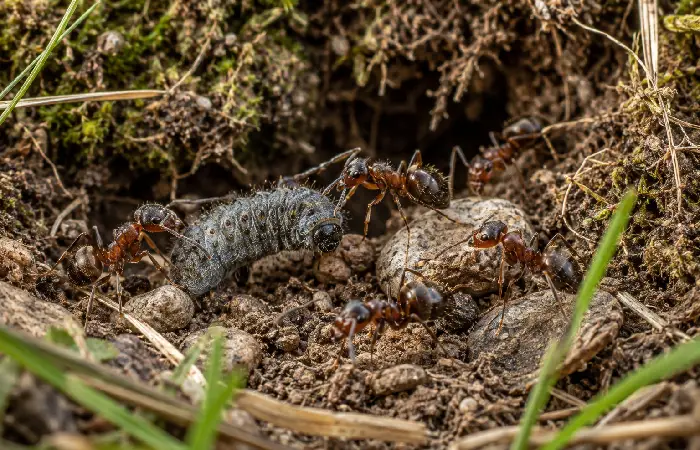
One of the most scientifically interesting examples discussed in the Pussmoth article involves Maculinea rebeli.
Scientific literature has documented highly specialised relationships between Maculinea butterflies and Myrmica ants.
Research shows that M. rebeli caterpillars can enter ant colonies and behave as social parasites. They can chemically mimic ant larvae, helping workers recognise and treat them as part of the colony.
Other research describes the complex life cycle of these butterflies, including their dependence on particular food plants and Myrmica host ants.
This is more than a strange curiosity. It is an example of evolutionary specialisation.
How the Butterfly–Ant Relationship Works
The relationship can be simplified into a sequence:
Butterfly lays egg on suitable host plant
↓
Caterpillar develops during its early stage
↓
Caterpillar reaches a later developmental stage
↓
It encounters foraging Myrmica ants
↓
Chemical signals help it gain acceptance
↓
Ants carry it into their nest
↓
Caterpillar exploits resources inside the colony
↓
It eventually pupates and emerges as an adult butterfly
Research has found evidence that chemical mimicry plays an important role in this process. Caterpillars can produce chemical signals resembling those of ant brood, helping them gain acceptance.
This is one of the strongest scientific examples supporting the idea that butterfly biology can be considerably more complicated than its appearance suggests.
Is Maculinea rebeli Really a “Butterfly Criminal”?
No.
Calling a butterfly a criminal, thief or villain is a storytelling device rather than a scientific classification.
The term social parasite is much more useful.
A social parasite is an organism that exploits the social organisation or resources of another species. In this case, specialised butterfly larvae exploit ant colonies.
Research has shown that Maculinea larvae can use different strategies within Myrmica colonies. Some species or forms can prey upon ant brood, while others mimic ant larvae and receive food from workers.
That makes the relationship fascinating from an evolutionary perspective.
Comparing the Main Behavioural Examples
| Behaviour | Butterfly Stage | Main Purpose | How Unusual Is It? |
| Nectar feeding | Adult | Energy | Common |
| Mud-puddling | Adult | Minerals and nutrients | Common in some groups |
| Feeding on unusual liquids | Adult | Nutrient acquisition | Less familiar to general audiences |
| Territorial fighting | Adult | Resource or mating competition | Species-dependent |
| Warning coloration | Adult/larva | Predator deterrence | Widespread |
| Pupal mating behaviour | Pupal/adult transition | Reproduction | Highly specialised |
| Ant exploitation | Caterpillar | Food and protection | Highly specialised |
| Chemical mimicry | Caterpillar | Avoid ant detection | Highly specialised |
The table illustrates why a single word such as “butterfly” covers an enormous range of ecological strategies.
How to Read the Pussmoth Article Critically
The Pussmoth article is engaging partly because it uses dramatic language. However, readers should separate storytelling from scientific terminology.
A good workflow is:
Step 1: Identify the biological claim
Ask what behaviour is actually being described.
Step 2: Identify the species
Different butterfly species can behave very differently.
Step 3: Check the life stage
A caterpillar, pupa and adult butterfly may have completely different behaviours.
Step 4: Look for scientific evidence
Research papers and university or museum sources can provide additional context.
Step 5: Avoid generalising
A behaviour observed in one species should not automatically be applied to every butterfly.
This approach makes articles such as Las mariposas se portan mal: Lo que no quieren que sepas more useful as starting points for further learning.
Pussmoth Compared With Typical Butterfly Websites
| Feature | Pussmoth Article | Typical Butterfly Guide |
| Main focus | Unusual behaviour | Identification and biology |
| Writing style | Dramatic and curiosity-driven | Usually instructional |
| Feeding behaviour | Strong emphasis | Often secondary |
| Reproductive behaviour | Discussed | Often briefly covered |
| Caterpillar behaviour | Highlighted | Usually life-cycle information |
| Ant relationships | Detailed example | May be omitted |
| Best for | Curious readers | Identification beginners |
| Scientific follow-up | Recommended | Depends on source |
The Pussmoth article therefore works best as an interesting introduction to unusual butterfly biology, rather than as a complete scientific reference.
Who Should Read This Article?
The subject is particularly suitable for:
- Butterfly enthusiasts
- Nature and wildlife readers
- Students studying insects
- Parents looking for unusual nature topics
- Gardeners interested in butterfly behaviour
- Readers interested in evolution
- People researching caterpillar behaviour
- Anyone curious about animal adaptations
It can also be useful as a jumping-off point for deeper research into Lepidoptera, ecological relationships and insect conservation.
Topic Clusters Covered by the Article
The source page sits within several related subject areas.
Butterfly Biology
Includes:
- Butterfly anatomy
- Metamorphosis
- Feeding
- Reproduction
- Defence
Caterpillar Behaviour
Includes:
- Herbivory
- Predation
- Parasite-like relationships
- Chemical defence
- Host interactions
Butterfly Ecology
Includes:
- Competition
- Mineral acquisition
- Food resources
- Predator avoidance
- Habitat
Interspecies Relationships
Includes:
- Ant–butterfly interactions
- Social parasitism
- Chemical mimicry
- Host specificity
These clusters create opportunities for readers to explore butterfly biology beyond the headline topic.
Pros and Limitations of the Article
Pros
- Makes unusual insect behaviour accessible.
- Introduces readers to lesser-known butterfly adaptations.
- Covers several different behavioural categories.
- Encourages readers to question simplified ideas about butterflies.
- Points towards fascinating subjects such as ant–butterfly relationships.
Limitations
- The title uses sensational language.
- Several claims need scientific context.
- Individual species should not be treated as representative of all butterflies.
- Popular explanations can simplify complex biological relationships.
- Some terminology may be uncomfortable or ambiguous when translated into human social language.
The best approach is to use the article as an introduction and consult scientific sources for specific claims.
Why This Topic Matters Beyond Curiosity
At first glance, unusual butterfly behaviour may seem like a collection of strange facts.
There is more to it than that.
Studying butterfly behaviour helps researchers understand:
- Evolution
- Natural selection
- Species interactions
- Ecosystem health
- Chemical communication
- Predator–prey relationships
- Biodiversity
- Conservation
The Maculinea–Myrmica relationship is particularly valuable because it shows how dependent some species can be on specific ecological partners. Research describes these butterflies as strongly associated with particular host plants and ant species.
That means protecting a butterfly can require protecting the wider ecosystem on which its life cycle depends.
Expectations: What You Should and Should Not Take From the Article
You should expect interesting examples of real butterfly behaviour, but not a complete catalogue of everything butterflies do.
You should not conclude that:
- All butterflies are aggressive.
- All colourful butterflies are poisonous.
- All caterpillars eat other animals.
- All butterflies drink unusual substances.
- All butterflies exploit ants.
- Butterflies are inherently dangerous.
Instead, the useful conclusion is that butterfly behaviour varies enormously between species and life stages.
That is the more scientifically accurate takeaway.
Practical Example: Understanding a Butterfly in Your Garden
Imagine finding a group of butterflies around a damp patch of soil.
The first assumption might be that they are simply resting.
A closer observation could reveal that they are repeatedly extending their proboscises into the wet soil.
Rather than feeding on flowers, they may be obtaining dissolved minerals.
Now consider finding a caterpillar on a plant.
Its behaviour may be completely different from that of the adult butterfly. It may spend most of its time eating leaves, hiding from predators or interacting with other organisms.
This simple example shows why identifying the life stage and species is important before drawing conclusions.
FAQ:
What is Las mariposas se portan mal: Lo que no quieren que sepas?
Las mariposas se portan mal: Lo que no quieren que sepas is a Pussmoth article about unusual butterfly and caterpillar behaviour, including feeding, competition, reproductive behaviour and interactions with ants.
Are the behaviours described in the article real?
Several of the behavioural themes have scientific parallels, particularly mud-puddling, specialised butterfly–ant relationships and chemical mimicry. However, individual claims should be considered in relation to the species being discussed rather than generalised to all butterflies.
Do butterflies really drink things other than nectar?
Yes. Some butterflies participate in mud-puddling and may obtain minerals and other nutrients from sources besides flowers. The Pussmoth article highlights several unusual examples.
Can butterfly caterpillars live with ants?
Some specialised butterfly caterpillars can live inside ant colonies. Research on Maculinea rebeli has found evidence of chemical mimicry that helps caterpillars interact with their Myrmica hosts.
Are butterflies dangerous to humans?
Most butterflies pose no meaningful danger to people. Some species and caterpillars have defensive chemicals or other protective adaptations, but unusual biological behaviour should not be confused with a threat to humans.
Conclusion
Butterflies misbehave: The secrets you don’t know It sets out an unusual, and probably more accurate, view of these colourful garden guests, rather than the classic, serene flower visitor. For the Pussmoth (Caterpillar Family of the Year) in particular, this journal describes very strange eating habits and competition, and some quite surprising ways of managing interactions with ants.
More to the point, the butterfly is not “bad”. Nature is messy. Research does indeed indicate that some butterfly species have some very sophisticated ways of dealing with the world, such as chemical mimicry and ant nest parasitism.
If you want more out of Las mariposas se portan mal: Lo que no quieren que sepas, you’d be best served using it as an introduction, then delving into species’ studies. When you see butterflies with ecological and evolutionary lenses, and not the human constructs of right and wrong, you can gain just how complex these insects actually are.