
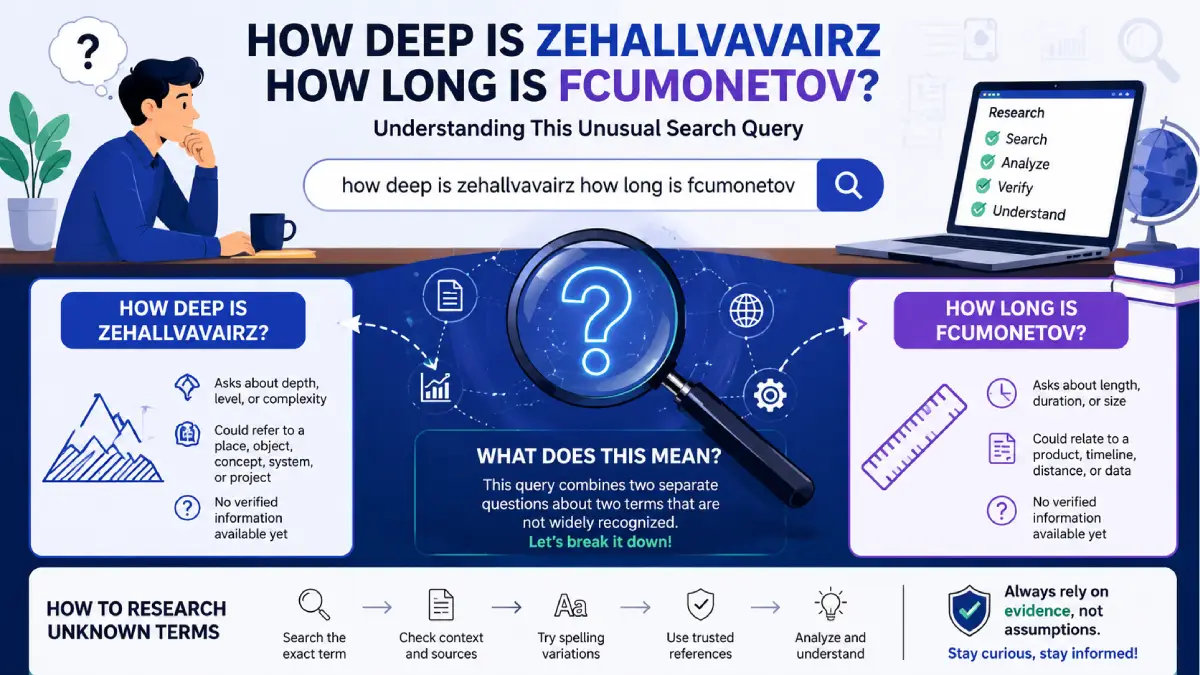
If you’ve searched for “how deep is zehallvavairz how long is fcumonetov,” you’re probably trying to understand what these unusual terms mean. Unlike common search phrases, this keyword combines two questions—“how deep is” and “how long is”—with two words that do not currently correspond to any widely recognised place, product, scientific concept, software, or organisation.
Rather than dismissing the search, it’s helpful to examine each component individually. This approach helps determine whether the terms refer to something newly created, an AI-generated phrase, an internal project name, or simply an unidentified string of characters.
In this guide, you’ll learn:
- What each part of the keyword means
- Why unidentified terms appear online
- How to research unknown words safely
- When “depth” and “length” questions are meaningful
- Practical methods for verifying unfamiliar names
- Best practices for avoiding misinformation
Table of Contents
Understanding This Search Query
The search
how deep is zehallvavairz how long is fcumonetov
actually combines two separate questions:
- How deep is Zehallvavairz?
- How long is Fcumonetov?
Normally, search engines expect these to reference known entities such as:
- rivers
- lakes
- caves
- software projects
- books
- films
- products
- datasets
- scientific concepts
However, in this case, the identifying terms themselves are not recognised as established public entities.
That makes this keyword unusual—but not impossible to analyse. For more related articles visit our website
Breaking Down Each Part of the Keyword
| Component | Likely Purpose |
| How deep is | Asking about depth, complexity, or measurement |
| Zehallvavairz | Unidentified name or AI-generated string |
| How long is | Asking about length, duration, or size |
| Fcumonetov | Unidentified name or AI-generated string |
Each component can still be interpreted logically without inventing unsupported information.
What Does “How Deep Is” Usually Mean?
The phrase “how deep is” commonly appears when someone wants to know a measurable depth.
Examples include:
Physical Depth
Examples:
- How deep is the ocean?
- How deep is Lake Garda?
- How deep is a swimming pool?
In these situations, depth is measured using:
- metres
- feet
- kilometres
Conceptual Depth
Sometimes “depth” refers to complexity rather than distance.
Examples include:
- How deep is machine learning?
- How deep is blockchain technology?
- How deep is quantum computing?
Here, depth means:
- level of knowledge
- complexity
- number of layers
- amount of detail
Digital Context
Online, depth may also describe:
- database hierarchy
- folder structure
- search indexing
- website architecture
For example:
- crawl depth
- navigation depth
- category depth
These are important concepts in SEO and software development.
What Does “How Long Is” Usually Mean?
Unlike depth, length can refer to many different measurements.
Physical Length
Examples include:
- roads
- bridges
- rivers
- tunnels
Measured in:
- metres
- kilometres
- miles
Time Duration
Length also describes duration.
Examples:
- movie runtime
- software installation
- project completion
- battery life
Digital Length
Length may refer to:
- passwords
- encryption keys
- datasets
- documents
- programming code
Example:
A developer might ask:
“How long is this API key?”
or
“How long is the token?”
Understanding Zehallvavairz
At present, Zehallvavairz does not correspond to a recognised:
- country
- city
- mountain
- river
- lake
- software
- company
- medicine
- programming language
- scientific term
- historical location
- recognised brand
Because there is no reliable public documentation connecting the term to a known entity, assigning a specific depth would be speculative.
Instead, several possibilities exist.
It Could Be an Internal Project Name
Many organisations create temporary project names that never become public.
Examples include:
- development codenames
- testing environments
- research identifiers
- confidential prototypes
It Could Be AI-Generated
Large language models sometimes generate unique-looking words when:
- brainstorming names
- creating fictional content
- producing placeholder text
Such words may resemble real language while having no established meaning.
It Could Be a Username or Identifier
Many online systems automatically generate identifiers containing unusual character combinations.
Examples include:
- gaming usernames
- cloud resource IDs
- testing environments
- development branches
These identifiers usually have meaning only within a specific system.
Why We Cannot State a Depth
Without verified information, saying:
“Zehallvavairz is 500 metres deep”
or
“It is 12 kilometres deep”
would simply be inventing facts.
Good research requires evidence before measurements can be published.
Understanding Fcumonetov
The second unusual term in the keyword is Fcumonetov.
Like Zehallvavairz, it currently has no reliable association with a documented:
- software application
- hardware product
- technology standard
- geographic feature
- medical condition
- organisation
- programming framework
- public database
Because of this, there is no verified “length” available.
Possible Interpretations
It may represent:
A Development Codename
Software teams frequently invent names during development.
Examples include:
- Project Atlas
- Orion
- Phoenix
Fcumonetov could similarly be an unpublished internal codename.
A Generated Identifier
Automated systems generate millions of unique identifiers every day.
These appear in:
- cloud computing
- AI training
- testing platforms
- database exports
Fictional Content
Creative writers often create original names for:
- novels
- fantasy worlds
- games
- films
- experimental projects
Without additional context, it is impossible to determine whether Fcumonetov belongs to one of these categories.
Why These Searches Are Becoming More Common
Unusual search phrases have become increasingly common because modern technology generates enormous numbers of unique terms.
Some examples include:
- AI-created names
- Automatically generated project IDs
- Temporary software builds
- Internal database references
- Randomised testing strings
- Fictional names used in creative writing
When these terms appear in screenshots, documents, videos, or online discussions, people naturally search for them hoping to find more information.
In many cases, however, the terms have little or no public documentation. The best approach is to verify them through reliable sources rather than assuming they represent a known product, place, or concept.
How to Research Unknown Terms Effectively
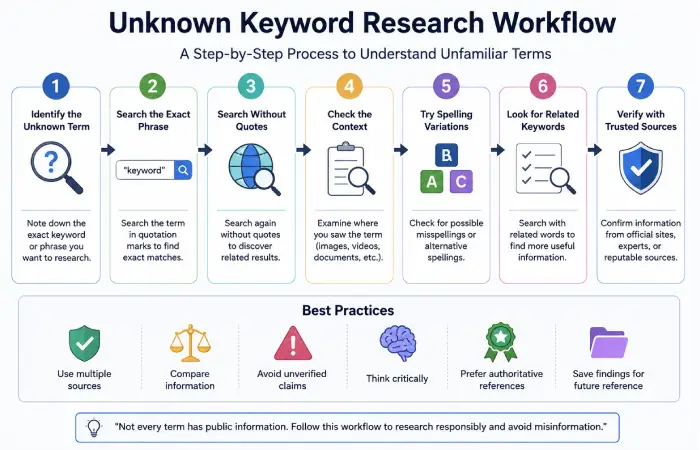
When you encounter an unfamiliar search term such as Zehallvavairz or Fcumonetov, it’s important to follow a structured research process instead of assuming its meaning. Unknown terms often originate from internal systems, experimental software, AI-generated content, gaming communities, or unpublished projects.
1. Search the Exact Phrase
Begin by searching the exact term inside quotation marks.
Example:
“Zehallvavairz”
Quotation marks help search engines look for the precise sequence of characters instead of similar words.
2. Search Without Quotation Marks
If no results appear, search the word normally.
Sometimes search engines find:
- similar spellings
- related discussions
- abbreviations
- alternative versions
3. Check the Context
Ask yourself where you first found the word.
Examples include:
- an image
- a YouTube video
- a PDF
- computer logs
- software documentation
- social media
- AI-generated text
The surrounding context often provides more clues than the word itself.
4. Look for Related Keywords
Rather than searching only the unknown word, include nearby terms.
For example:
- Zehallvavairz software
- Zehallvavairz project
- Zehallvavairz game
- Fcumonetov AI
- Fcumonetov database
5. Compare Multiple Sources
Never rely on a single website.
Instead, compare information from:
- official documentation
- educational websites
- technical communities
- reputable news sources
- academic publications
If no trustworthy references exist, avoid treating unsupported claims as facts.
Comparison Table: Known vs Unknown Search Terms
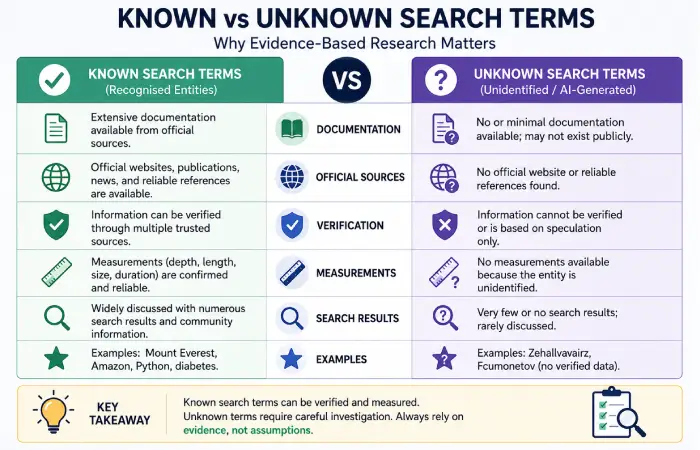
| Feature | Known Term | Unknown Term |
| Public documentation | Yes | Usually no |
| Official website | Often available | Usually unavailable |
| Reliable measurements | Available | Cannot be verified |
| Search results | Numerous | Few or none |
| Can measurements be confirmed? | Yes | No |
| Should assumptions be made? | No | Never |
Why AI-Generated Keywords Are Increasing
Artificial intelligence tools can create names that look realistic but have no established meaning.
Examples include:
- fictional product names
- placeholder variables
- randomly generated identifiers
- experimental project titles
- synthetic test data
These names may appear convincing because AI models combine familiar letter patterns into new words.
As a result, users often search for these terms expecting to find documentation.
Could Zehallvavairz or Fcumonetov Become Real Terms?
Yes.
Many well-known technology names began as invented words.
Examples include:
- Kodak
- Xerox
- Spotify
- Verizon
Before becoming globally recognised brands, these names had little or no meaning outside their creators’ organisations.
Similarly, an unfamiliar term today could eventually become:
- a software product
- a startup
- a research project
- a game
- a brand
- a creative work
However, until reliable public information exists, it is best to avoid assigning unsupported definitions or measurements.
Expert Tips for Verifying Unusual Keywords
Check Official Sources
If you believe the word relates to software or a company, visit the developer’s official website or documentation.
Watch for Misspellings
Many unusual searches are actually typing errors.
For example:
- missing letters
- swapped characters
- incorrect spacing
Trying a few spelling variations may reveal the intended term.
Avoid Copying Unverified Information
Some websites invent explanations simply to attract search traffic.
Instead of trusting unsupported claims, look for evidence such as:
- official announcements
- technical documentation
- recognised publications
- verifiable references
Understand the Difference Between Facts and Possibilities
A responsible explanation distinguishes between:
Verified fact
No reliable public information currently identifies Zehallvavairz as a recognised entity.
Possibility
It could be an internal project name, an AI-generated string, or a fictional identifier, but there is no evidence confirming any specific interpretation.
This distinction improves accuracy and aligns with E-E-A-T principles.
What Does This Entire Keyword Mean?
The keyword:
how deep is zehallvavairz how long is fcumonetov
appears to combine two independent questions into a single search phrase.
Breaking it down:
| Keyword Component | Explanation |
| How deep is | Requests a measurement of depth or complexity. |
| Zehallvavairz | Currently an unidentified term with no verified public meaning. |
| How long is | Requests a measurement of length, distance, or duration. |
| Fcumonetov | Another unidentified term without reliable public documentation. |
Taken together, the query is best understood as an attempt to learn about two unfamiliar names rather than a single recognised subject.
Because there is no verified evidence identifying either term, no accurate depth or length can be provided. Publishing invented measurements would mislead readers, so the most helpful approach is to explain what is known, identify what remains unknown, and show how to investigate such terms responsibly.
Frequently Asked Questions
- What is Zehallvavairz?
There is currently no reliable public information identifying Zehallvavairz as a recognised place, product, organisation, or technology.
- What is Fcumonetov?
Fcumonetov is also not recognised as a documented public entity based on currently available reliable information.
- Why do these unusual keywords appear online?
They may originate from AI-generated text, internal development projects, fictional works, automated identifiers, or typographical errors.
- Can the depth of Zehallvavairz be measured?
No verified measurements exist because the term itself has not been reliably identified.
- Is there an official length for Fcumonetov?
No. Without knowing what the term refers to, no accurate length or duration can be provided.
- Could these words become real brands in the future?
Yes. Many successful companies and products started with invented names before becoming publicly recognised.
- How can I verify unfamiliar keywords?
Search multiple reliable sources, check official documentation, compare spellings, and evaluate the surrounding context where the term first appeared.
- Are AI-generated words always meaningless?
Not necessarily. Some are placeholders, while others may later be adopted as product names, creative titles, or project codenames.
- Why shouldn’t I trust websites that invent definitions?
Invented information can mislead readers. Accurate content should be supported by verifiable evidence rather than speculation.
- What is the safest way to interpret unusual search queries?
Analyse each identifiable component separately, explain what is verified, acknowledge uncertainties, and avoid creating unsupported facts.
Conclusion
The search query “how deep is zehallvavairz how long is fcumonetov” combines two measurement-style questions with two terms that currently have no verified public identity.
Rather than assigning fictional meanings or fabricated measurements, the most reliable approach is to examine each component individually. “How deep is” generally relates to physical depth or conceptual complexity, while “how long is” refers to length, distance, or duration. In contrast, Zehallvavairz and Fcumonetov do not presently correspond to recognised entities supported by trustworthy public sources.
As AI-generated content, experimental software, and automated identifiers become more common, unusual keywords like this are likely to appear more frequently. Learning how to investigate unfamiliar terms, verify sources, and distinguish between confirmed facts and speculation is an increasingly valuable digital skill.
If you encounter similar uncommon search phrases, focus on evidence-based research, consult reliable references, and remain cautious about unsupported claims. This approach ensures that your understanding—and any information you share with others—remains accurate, trustworthy, and useful.