
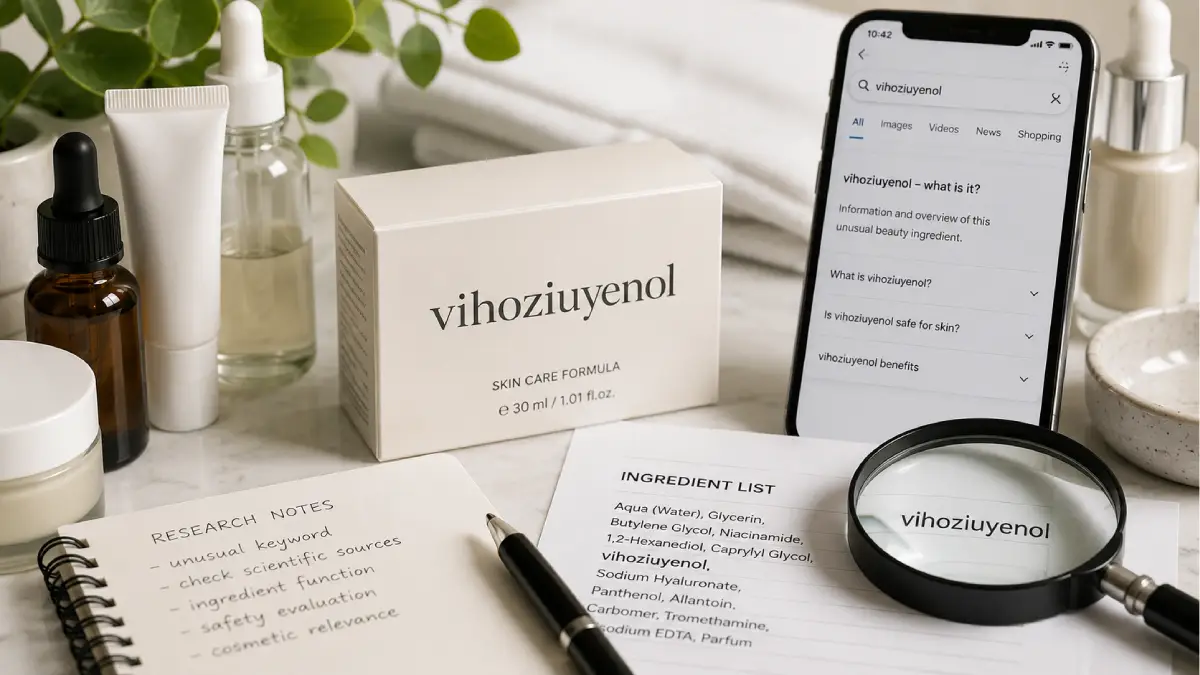
If you recently have searched or heard the termvihoziuyenol, you are not alone. The wordvihoziuyenolis an unusual search term, and you’ve likely had questions aboutvihoziuyenol: what does it mean, is it a beauty/skincare word, and is this reason why it keeps coming up in your searches? At first glance, vihoziuyenolappears to be an ingredient name, a beauty brand, product, or other technical keyword related to skincare or health.
However, we’re cautious about searching words unfamiliar to us without more information to clearly define its meaning.
In this article, let’s delve deeper into whatvihoziuyenolmight be and what you can do to identify and verify unfamiliar skincare and beauty terminology.
Table of Contents
What Is Vihoziuyenol?
Vihoziuyenol is an unusual search term without an obvious, widely recognised definition. It does not immediately correspond to a commonly known skincare ingredient, cosmetic category, or established beauty term.
That does not necessarily mean the keyword has no purpose. Unusual terms can originate from several sources, including product codes, usernames, automatically generated text, misspellings, website indexing, or newly introduced product and brand names.
For this reason, it is better to avoid assigning a specific meaning to vihoziuyenol without reliable evidence.
Is Vihoziuyenol a Skincare Ingredient?
There is currently no strong basis for treating vihoziuyenol as a standard skincare Ingredient.
The commonly-used cosmetic ingredients all have more or less recognisable names, and may be found and verified by using ingredient databases, cosmetic labels, manufacturer data or any trusted authorities. These include, but are not limited to; glycerin, niacinamide, hyaluronic acid, salylic acid and vitamin C.
Vihoziuyenol does not fit the same recognizable pattern as commonly-used cosmetic ingredients above.
Should you encounter the term on a cosmetic package, you are recommended to examine the ingredient list carefully, together with the manufacturer, product name, and cosmetic package details, but make a quick assumption that it implies an active cosmetic ingredie.
Why Are People Searching for Vihoziuyenol?
There are several possible reasons an unfamiliar keyword can suddenly appear in search results.
1. It Could Be a Misspelling
One possibility is that vihoziuyenol is a misspelled version of another word or phrase.
Search engines frequently receive queries containing typing mistakes, unusual spellings and incomplete words. A single incorrect character can make a familiar term look completely different.
2. It Could Be a Product or Internal Code
Some products use internal reference numbers, batch identifiers, catalogue codes or unusual naming systems.
If vihoziuyenol appears alongside numbers, barcodes, packaging information or a product reference, it may be an identifier rather than a beauty ingredient.
3. It Could Be Automatically Generated Text
Websites sometimes generate pages, URLs, tags or database entries automatically. This can produce combinations of letters that do not have a conventional dictionary meaning.
Such terms can still become visible to search engines if automatically generated pages are indexed.
4. It Could Be a Username or Digital Identifier
Another possibility is that the term belongs to an account, profile, online listing or other digital resource.
In that situation, vihoziuyenol would identify something online rather than describe a skincare ingredient or cosmetic benefit.
5. It Could Be a Newly Introduced Name
Brands occasionally introduce new product names that initially have little information available online.
If vihoziuyenol is associated with a recently launched beauty product, additional information may eventually appear through official product pages, packaging and retailer listings.
Could Vihoziuyenol Be a Beauty Product?
It is possible for an unfamiliar word to be used as a product name, but the name alone does not prove that it is a beauty product.
Before considering vihoziuyenol a cosmetic product, look for supporting details such as:
- An official manufacturer
- A complete product name
- Product packaging
- An ingredient list
- A company website
- Directions for use
- Product size or specifications
- Batch or manufacturing information
- Reliable retailer information
These details help distinguish a genuine cosmetic product from an unexplained keyword.
How to Check an Unfamiliar Skincare Term

If you encounter vihoziuyenol on a website, social media post or product listing, use a few simple verification steps.
Check the Original Source
Start with the page where you first saw the term.
Look at the surrounding text. Does it appear next to a product name, ingredient list, company name, URL, username or reference number?
Context can often provide more information than the keyword itself.
Look for the Manufacturer
A legitimate cosmetic product should normally have identifiable information about the company responsible for manufacturing or distributing it.
Check the packaging or official product page for the company name and contact information.
Read the Ingredient List
If vihoziuyenol is supposedly an ingredient, check whether the complete ingredient list is available.
Do not rely solely on a social media caption, marketplace description or promotional article when evaluating a cosmetic ingredient.
Check Multiple Reliable Sources
One webpage may contain incorrect or automatically generated information.
Compare the term across several independent sources. If the same spelling, product details and manufacturer information appear consistently, there is stronger evidence that the term refers to a real product or entity.
What Should You Do If You Find Vihoziuyenol on a Cosmetic Product?
If you encounter the word on a skincare or beauty product, avoid making assumptions based only on its name.
Instead, check:
- The complete product label.
- The manufacturer or brand.
- The ingredient list.
- The product’s intended use.
- Directions and warnings.
- Batch or lot information.
- Official product documentation.
If important information is missing, it may be better to avoid using the product until its identity and ingredients can be properly verified.
Why Product Labels Matter
Cosmetic labels provide useful information that cannot always be determined from a product name.
A label may identify the manufacturer, ingredients, product quantity, directions, warnings and other information required for consumers.
This is particularly important when dealing with unfamiliar terms. A word such as vihoziuyenol may look scientific or technical, but appearance alone does not establish what a substance is or what it does.
Consumers should therefore evaluate the complete product information rather than relying on the name of a product or keyword. For more related articles visit our website.
Vihoziuyenol and Online Beauty Searches
Unusual keywords can become searchable for many reasons. Search engines collect information from websites, product pages, directories, social platforms and other online resources.
When a rare term appears, search results may not immediately provide a definitive explanation. Some pages may simply repeat the keyword without adding useful information.
This is why search volume or the existence of several webpages does not automatically prove that a term is an established beauty ingredient.
For readers researching vihoziuyenol, the most useful approach is to distinguish between what can be verified and what is only speculation.
Common Mistakes When Researching Unknown Beauty Terms
Assuming the Name Is an Ingredient
A technical-looking word is not automatically a cosmetic ingredient.
Trusting a Single Website
One webpage may contain incomplete or inaccurate information. Look for corroborating sources.
Confusing Product Names With Ingredients
A product can have a unique commercial name while containing completely different ingredients.
Ignoring the Product Label
The physical packaging can provide information that is missing from search results.
Assuming Search Results Confirm Safety
Search engines help locate information, but appearing in search results does not mean that a product or ingredient has been independently verified as safe or effective.
Frequently Asked Questions
What is vihoziuyenol?
Vihoziuyenol is an unusual term with no clear, widely recognised definition. It should not automatically be classified as a skincare ingredient, cosmetic product or established beauty term without reliable supporting information.
Is vihoziuyenol a skincare ingredient?
There is not enough reliable evidence to identify vihoziuyenol as a standard skincare ingredient. If you encounter the term on a product, check the complete ingredient list and manufacturer information.
Is vihoziuyenol a beauty product?
The keyword itself does not establish that it is a beauty product. Additional information such as a product label, manufacturer, official website or retailer listing would be needed to identify it accurately.
Is vihoziuyenol safe?
Safety cannot be determined from the name alone. If the term appears on a cosmetic product, identify the actual product and review its complete ingredients, directions and warnings before use.
Could vihoziuyenol be a misspelling?
Yes. Unusual online keywords can sometimes result from typing errors, altered spellings or automatically generated text. Checking the original context can help determine whether the spelling is intentional.
Where can I find reliable information about vihoziuyenol?
Start with the original source where you encountered the term, then check official manufacturer information, product packaging and reputable cosmetic information sources. Avoid relying on unsupported claims from pages that simply repeat the keyword.
Final Thoughts
Vihoziuyenol is a funny and peculiar keyword as it does not yet have a widely-accepted meaning within the beauty and skincare sphere. Instead of guessing that this is either an ingredient, a cosmetic product or even a new cosmetic brand it is rather more prudent to investigate the places in whichvihoziuyenol might appear. When you discover vihoziuyenol on a beauty product please concentrate instead on reliable and authoritative data sources such as, the manufacturer, list of ingredients on the product, labeling on the product and even original source documents or technical specifications related to the product, rather than automatically accept or reject information found on the internet as being valid.
One of the simplest and most useful habits one should cultivate in any online research on beauty and skincare is to look up any unusual or not immediately identifiable information to gain an understanding of the term you have come across before accepting and believing information provided regarding a product and/or ingredient.