
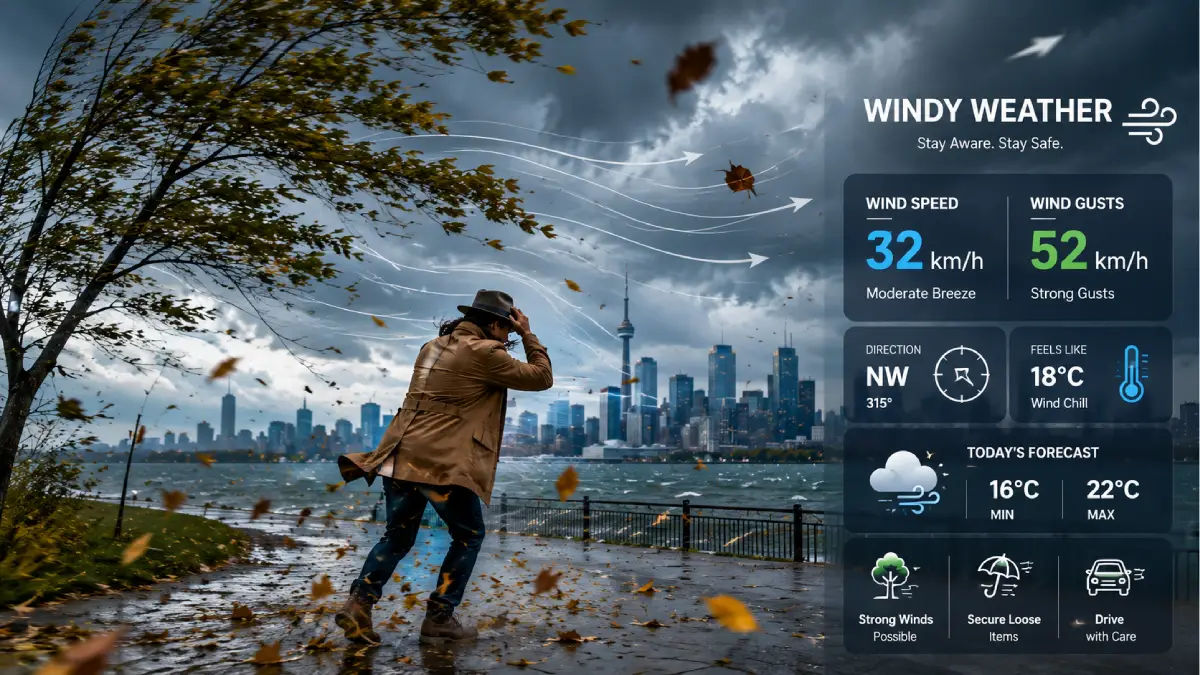
Windy weather refers to those weather conditions when the air is perceptibly blowing or rushing across the ground. The generation of winds mainly depends on the pressure differences of the air acting as a driving force for the displacement of air from a region with high air pressure toward a region with low air pressure. The wider the gradient of the air pressure between regions, the more significant wind velocity it produces.
Wind phenomena are typical constituents of Earth’s atmospheric system.
Slight breeze enhances pleasantness of a hot summer afternoon; high winds pose hindrances for traveling, leisure activities, tree movement, damage of buildings, aerial and marine transportations.
So, comprehending windy conditions goes beyond just determining “is it windy”. Comprehension implies observing wind’s speed, direction, gust behavior, pressure, temperature and the ambient topography. This guideline expounds windy weather: conception, causes of wind, estimation methods, interpretation of windy weather in forecasts and wind chill, safety measures required against high winds etc.
Table of Contents
What Is Windy Weather?
Windy weather is when the air is moving with enough force to make it detectable and of some magnitude at the Earth’s surface. Wind is the horizontal movement of air across an imaginary perpendicular plane. Wind speed as definition that relates to windy by “wind from the west at 20 to 30 miles per hour.”
The US National Weather Service has definition that indicates that any spot may be described as windy and have specific standards as defined.
There is no ‘true’ standard speed that determines if an area or individual feels as windy. A seaside neighborhood may be accustomed to higher sustained winds than some other region, so in that sense a speed that’s common there, could be perceived as windy inland areas where houses and other obstacles might break up air current at the local level of Earth’s surfacel.
Simple Example
Imagine two afternoons:
Day A:
Temperature: 28°C
Wind: 5 km/h
Conditions: Mostly calm
Day B:
Temperature: 28°C
Wind: 35 km/h
Conditions: Noticeably windy
Although the air temperature is identical, Day B will feel very different because moving air affects how people perceive the conditions.
What Causes Windy Weather?
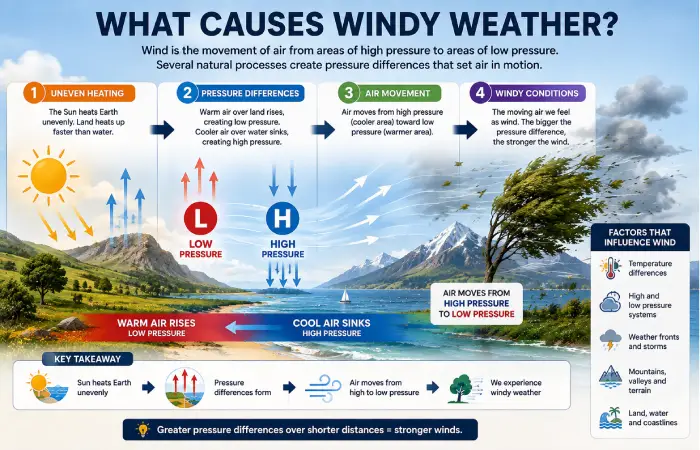
The basic cause of wind is unequal air pressure.
When pressure differs between two areas, air is accelerated from higher pressure towards lower pressure. The pressure gradient force is the atmospheric force associated with this movement. A stronger pressure gradient generally produces stronger winds.
Several processes can create or strengthen these pressure differences.
1. Uneven Heating of Earth’s Surface
The Sun does not heat every part of Earth’s surface equally.
Land, water, vegetation and different types of terrain absorb and release heat at different rates.
This uneven heating contributes to differences in air temperature and pressure.
Those differences can help produce wind.
2. High- and Low-Pressure Systems
Weather systems are another major factor.
A low-pressure system is often associated with rising air and changing weather, while high-pressure systems generally involve sinking air.
The pressure gradient around these systems can create stronger winds.
3. Temperature Differences
Large temperature contrasts can contribute to stronger pressure gradients.
This is one reason why winds can become stronger when different air masses meet.
4. Weather Fronts
When air masses with different temperatures and characteristics interact, atmospheric pressure and wind patterns can change.
A passing front can therefore bring a noticeable shift in wind speed or direction.
5. Local Geography
The landscape can modify wind.
Mountains can channel air through gaps and valleys. Coastal areas can experience changing winds because land and water heat differently. Urban buildings can also redirect and accelerate airflow around streets and structures.
Why Are Some Days Windier Than Others?
Wind changes continuously.
One day might be calm while the following day is noticeably windy because the atmospheric pressure pattern has changed.
A particularly important factor is the pressure gradient.
Think of it like a slope.
A gentle slope represents a small pressure difference spread over a large distance.
A steep slope represents a larger pressure difference over a shorter distance.
The steeper the pressure gradient, the greater the force available to accelerate air.
The National Weather Service explains that the greater the pressure difference and the closer together the pressure systems are, the stronger the wind can become.
Other factors can also contribute, including:
- Moving weather fronts
- Strong low-pressure systems
- Temperature contrasts
- Thunderstorms
- Mountain terrain
- Coastal effects
- Seasonal weather patterns
- Local topography
Wind Speed vs Wind Gust
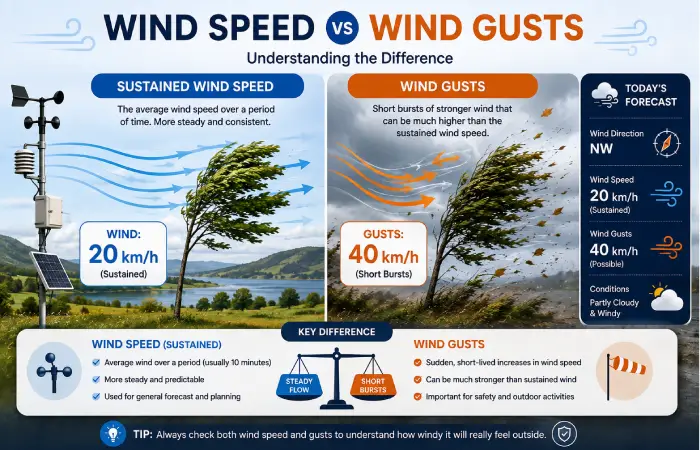
One of the most important things to understand when reading a weather forecast is the difference between wind speed and wind gusts.
Wind Speed
Wind speed usually represents an average or sustained measurement over a specified period.
For example:
Wind: 20 km/h
This gives you an indication of the general wind conditions.
Wind Gust
A gust is a shorter-lived increase in wind speed.
You might see a forecast such as:
Wind: 20 km/h
Gusts: 38 km/h
This means the general wind may be around 20 km/h, but brief stronger bursts could reach approximately 38 km/h.
The National Weather Service describes a wind gust as a rapid fluctuation in wind speed, while the Met Office explains that forecast wind speed represents an average and that actual wind can strengthen and weaken above and below that value.
Why Gusts Matter
Gusts can be particularly important for:
- Driving
- Cycling
- Motorcycling
- Hiking
- Construction
- Aviation
- Boating
- Outdoor events
- Working at height
A forecast with moderate sustained wind but significantly higher gusts deserve more attention than the sustained figure alone might suggest.
What Does Wind Direction Mean?
Wind direction tells you where the wind is coming from.
This can be confusing because weather forecasts normally name wind according to its source direction.
For example:
A north wind comes from the north and moves towards the south.
A west wind comes from the west and moves towards the east.
The Met Office explains that a wind labelled “S” is coming from the south, while the arrow shows its movement direction.
Wind direction is useful because it can help explain:
- Temperature changes
- Coastal conditions
- Smoke movement
- Air pollution transport
- Sailing conditions
- Weather changes
- Local precipitation patterns
How Is Wind Speed Measured?
Wind speed can be measured using an anemometer.
Weather stations commonly measure wind at a standard height so observations from different locations can be compared.
The Met Office notes that wind measurements are made at approximately 10 metres above ground level, partly because trees, buildings and other obstacles near the surface can distort measurements.
Wind speed may be reported in:
- Kilometres per hour (km/h)
- Miles per hour (mph)
- Metres per second (m/s)
- Knots
Quick Conversion Guide
| Measurement | Approximate equivalent |
| 10 km/h | 6.2 mph |
| 20 km/h | 12.4 mph |
| 30 km/h | 18.6 mph |
| 40 km/h | 24.9 mph |
| 50 km/h | 31.1 mph |
| 60 km/h | 37.3 mph |
| 100 km/h | 62.1 mph |
These conversions are useful when comparing forecasts from weather services that use different units.
Beaufort Wind Scale Explained
The Beaufort scale is a traditional system for describing wind intensity.
It was originally associated with observations of sea conditions and is still used, particularly in marine forecasting. The Met Office provides wind-speed ranges and descriptive terms from calm conditions through hurricane-force winds.
| Beaufort Force | Approx. Mean Wind Speed | Description |
| 0 | <1 knot | Calm |
| 1 | 1–3 knots | Light air |
| 2 | 4–6 knots | Light breeze |
| 3 | 7–10 knots | Gentle breeze |
| 4 | 11–16 knots | Moderate breeze |
| 5 | 17–21 knots | Fresh breeze |
| 6 | 22–27 knots | Strong breeze |
| 7 | 28–33 knots | Near gale |
| 8 | 34–40 knots | Gale |
| 9 | 41–47 knots | Strong gale |
| 10 | 48–55 knots | Storm |
| 11 | 56–63 knots | Violent storm |
| 12 | 64+ knots | Hurricane |
The exact effects depend on the environment, and the Beaufort scale should not be treated as a universal safety-warning system.
What Is Wind Chill?
Wind chill describes how cold conditions feel when wind and low air temperature occur together.
It is based on the rate of heat loss from exposed skin. As wind speed increases, heat can be removed from the body more quickly, making cold conditions feel colder.
For example, suppose the actual air temperature is:
0°F (-18°C)
with a wind speed of:
15 mph
The US National Weather Service gives a wind-chill value of approximately -19°F (-28°C) under those conditions.
Important Wind-Chill Fact
Wind chill does not mean that the actual air temperature has changed to the calculated value.
It describes the cooling effect experienced by exposed skin.
The distinction matters.
For example, wind chill cannot make a car radiator or water pipe physically reach a temperature below the actual surrounding air temperature simply because it is windy.
How Windy Weather Affects People
Wind can influence comfort, health and daily activities.
Outdoor Comfort
A strong breeze can make warm conditions feel more comfortable by increasing evaporation and moving air around the body.
But the same wind can make cool conditions feel considerably colder.
Cold Exposure
In cold weather, wind increases heat loss from exposed skin.
People spending long periods outside should therefore consider both temperature and wind conditions.
Allergies and Airborne Particles
Wind can transport pollen, dust and other particles through the air.
For people sensitive to airborne particles, windy conditions can sometimes make outdoor exposure less comfortable.
Visibility
Strong winds can lift dust, sand, snow or other particles, potentially reducing visibility.
This can become particularly important for road users and aircraft.
How Wind Affects Travel and Transportation
Wind can influence several forms of transportation.
Driving
Strong crosswinds can make driving more difficult, particularly for:
- Motorcycles
- Bicycles
- High-profile vehicles
- Trailers
- Trucks
- Vehicles crossing exposed bridges
Drivers should reduce speed and follow local warnings when conditions become hazardous.
Aviation
Wind speed and direction are important to aviation.
Aircraft operations consider wind when planning take-offs, landings and routes.
Boating
Wind can create waves and rougher water.
The Beaufort scale itself is historically connected with descriptions of sea conditions, making wind especially important for marine activities.
Cycling
Strong gusts can affect balance, particularly in exposed locations.
A cyclist may also experience changing resistance when travelling against, across or with the wind.
Windy Weather and the Environment
Wind is an essential part of Earth’s climate and weather systems.
It transports heat and moisture around the planet and influences clouds, precipitation and ocean conditions.
Wind also affects ecosystems.
Seed Dispersal
Some plants rely on wind to transport seeds and pollen.
Ocean Waves
Wind transfers energy to the surface of the water and contributes to the development of waves.
Wildfire Behaviour
Wind can influence the movement and intensity of wildfires by transporting heat and embers and supplying oxygen.
Because wildfire behaviour is complex, wind speed and direction are important factors considered by fire-management authorities.
Renewable Energy
Wind can also be converted into electricity through wind turbines.
Unlike fossil-fuel combustion, wind power generates electricity without directly burning fuel during operation.
How to Read a Wind Forecast
A wind forecast usually provides several pieces of information.
Imagine a forecast says:
Wind: NW 22 km/h
Gusts: 40 km/h
Here’s what it means:
NW: The wind is coming from the northwest.
22 km/h: This represents the expected general or average wind speed for the forecast period.
40 km/h: Brief stronger gusts may reach approximately this speed.
The Met Office similarly explains that forecast wind speed represents an average, while gust information represents higher short-term speeds.
What to Check
Before planning an outdoor activity, look at:
- Sustained wind speed
- Maximum gusts
- Wind direction
- Temperature
- Precipitation
- Visibility
- Official weather warnings
- Local terrain
This gives a much better picture than looking at wind speed alone.
When Does Wind Become Dangerous?
There is no single wind speed that is dangerous in every situation.
Risk depends on:
- Wind speed
- Gust speed
- Duration
- Terrain
- Buildings
- Trees
- Ground conditions
- Whether you are driving or boating
- Whether objects are secured
- Other weather conditions
A 40 km/h wind in one environment may be manageable, while stronger gusts combined with saturated ground, thunderstorms or damaged trees can create substantially greater hazards.
Official weather warnings should always take priority over generic wind-speed rules.
The US National Weather Service, for example, defines specific warning and advisory criteria that can vary according to location and weather situation.
Windy Weather Safety Tips
When strong winds are forecast, a few basic precautions can reduce risk.
Before the Wind Arrives
Secure or bring inside loose outdoor items such as:
- Garden furniture
- Lightweight decorations
- Umbrellas
- Bins
- Temporary signs
- Loose equipment
Close windows and doors properly.
During Strong Winds
Avoid unnecessary exposure, especially nearby:
- Large trees
- Construction sites
- Scaffolding
- Unsecured structures
- Coastal cliffs
- Exposed bridges
While Driving
Reduce speed if strong crosswinds or gusts affect vehicle control.
Maintain extra distance from other vehicles and be particularly careful when passing exposed areas.
During Cold Wind
Dress for both the air temperature and wind.
Protect exposed skin when wind chill becomes significant.
The National Weather Service recommends limiting exposure during dangerous wind-chill conditions and protecting vulnerable body areas.
Different Types of Wind
“Wind” is a broad term. Several types and patterns are commonly discussed in meteorology.
Sea Breeze
During suitable conditions, differences in heating between land and water can produce a breeze that moves from sea towards land.
Land Breeze
At other times, particularly overnight, the direction can reverse as land cools more quickly than water.
Mountain and Valley Winds
Terrain can channel air through valleys and influence local wind direction.
Gusty Winds
These involve noticeable short-term changes in wind speed.
Strong Gradient Winds
Large atmospheric pressure differences can generate widespread strong winds.
Storm Winds
Storm systems can produce much stronger winds, often accompanied by rain, snow, thunderstorms or other hazards.
The exact characteristics depend on the weather system and geographical location.
Windy Weather vs Stormy Weather
These terms are related but not interchangeable.
| Feature | Windy Weather | Stormy Weather |
| Strong wind | Possible | Often possible |
| Rain | Not required | Often possible |
| Thunder | Not required | May occur |
| Lightning | Not required | May occur |
| Snow | Not required | Possible |
| Hazard level | Can range from mild to dangerous | Often higher, depending on storm |
| Duration | Variable | Variable |
A day can be windy without being stormy.
For example, a strong pressure gradient could produce a very windy but otherwise dry day.
Likewise, a storm can include wind along with heavy rain, lightning, hail or snow.
What Does “Very Windy” Mean?
“Very windy” is a descriptive phrase rather than a universal scientific threshold.
Its meaning depends on the weather service, location and context.
When someone says the weather is very windy, they may be describing:
- Strong sustained winds
- Frequent strong gusts
- Difficulty walking
- Trees moving significantly
- Wind-blown debris
- Rough water
- Difficult driving conditions
For precise information, look at the actual wind speed and gust forecast rather than relying only on descriptive words. For more related articles visit our website
What Does This Entire Keyword Mean?
The keyword “windy weather” is straightforward rather than a combination of unrelated terms.
It consists of two meaningful words:
“Windy”
“Windy” describes conditions in which wind is noticeable or relatively strong. The National Weather Service glossary uses “windy” for sustained winds of approximately 20–30 mph in its terminology.
“Weather”
Weather refers to the atmospheric conditions occurring at a particular time and place.
Therefore:
Windy weather means atmospheric conditions in which moving air is strong or noticeable enough to be an important feature of the weather.
Someone searching windy weather may be looking for a definition, today’s wind forecast, an explanation of strong winds, information about wind chill, or advice about what to do during windy conditions.
The exact intent depends on the searcher’s location and context.
Expert Tips for Understanding Windy Weather
Tip 1: Don’t Look at Temperature Alone
A temperature of 10°C can feel quite different in calm conditions compared with strong wind.
Tip 2: Check Gusts
Sustained wind tells you about the general conditions. Gusts can tell you about short periods of significantly stronger wind.
Tip 3: Check Direction
Wind direction can influence how conditions change during the day.
Tip 4: Consider Your Location
The same forecast wind speed can feel different in a city, valley, coastline or open field.
Tip 5: Check Official Warnings
When strong winds are expected, official weather warnings are more useful for safety decisions than generic definitions.
Tip 6: Don’t Confuse Wind Chill With Actual Temperature
Wind chill describes how cold exposed skin feels; it does not change the actual measured air temperature.
Frequently Asked Questions
- What is windy weather?
Windy weather occurs when air is moving noticeably or strongly across an area. Wind is caused primarily by differences in atmospheric pressure.
- What causes windy weather?
Windy conditions can result from pressure differences, weather systems, temperature contrasts, fronts and local geographical effects such as mountains and coastlines.
- What wind speed is considered windy?
There is no universal threshold. The National Weather Service glossary uses sustained winds of about 20–30 mph as a definition of “windy” in its terminology.
- What is the difference between wind speed and wind gust?
Wind speed generally describes the expected average or sustained movement of air, while a gust is a shorter-lived increase in wind speed.
- Does wind make the temperature colder?
Wind can make people feel colder because it increases heat loss from exposed skin. This effect is called wind chill.
- What does a north wind mean?
A north wind comes from the north and moves towards the south. Weather forecasts normally identify wind direction by where the wind originates.
- How is wind measured?
Wind speed is commonly measured with an anemometer. Weather stations use standard measurement heights to make observations more comparable between locations.
- What is the Beaufort scale?
The Beaufort scale is a system for describing wind intensity using numbered forces and descriptive terms such as calm, breeze, gale and storm.
- Is windy weather dangerous?
It can be, depending on wind speed, gusts, location and other weather conditions. Strong winds can affect trees, structures, transportation and outdoor activities.
- How should I prepare for windy weather?
Secure loose outdoor objects, stay away from hazardous structures and trees during severe winds, drive carefully and follow official local weather warnings.
Conclusion
Windy weather is a normal but important part of Earth’s atmospheric system. Wind develops primarily because differences in air pressure create forces that move air, with stronger pressure gradients generally producing stronger winds.
Understanding windy conditions requires more than checking one number. Wind speed, gusts, direction, temperature, wind chill and local geography all contribute to how the weather feels and how it affects everyday activities.
The Beaufort scale provides a useful way to describe wind intensity, while modern weather forecasts provide more specific information about expected speeds and gusts.
If you searched “windy weather” because you want to understand today’s conditions, the most useful next step is to check a location-specific forecast and look at sustained wind, gusts, direction and official warnings.
For general education, the key idea is simple: wind is moving air, but the effects of that movement can range from a pleasant breeze to genuinely hazardous conditions.