
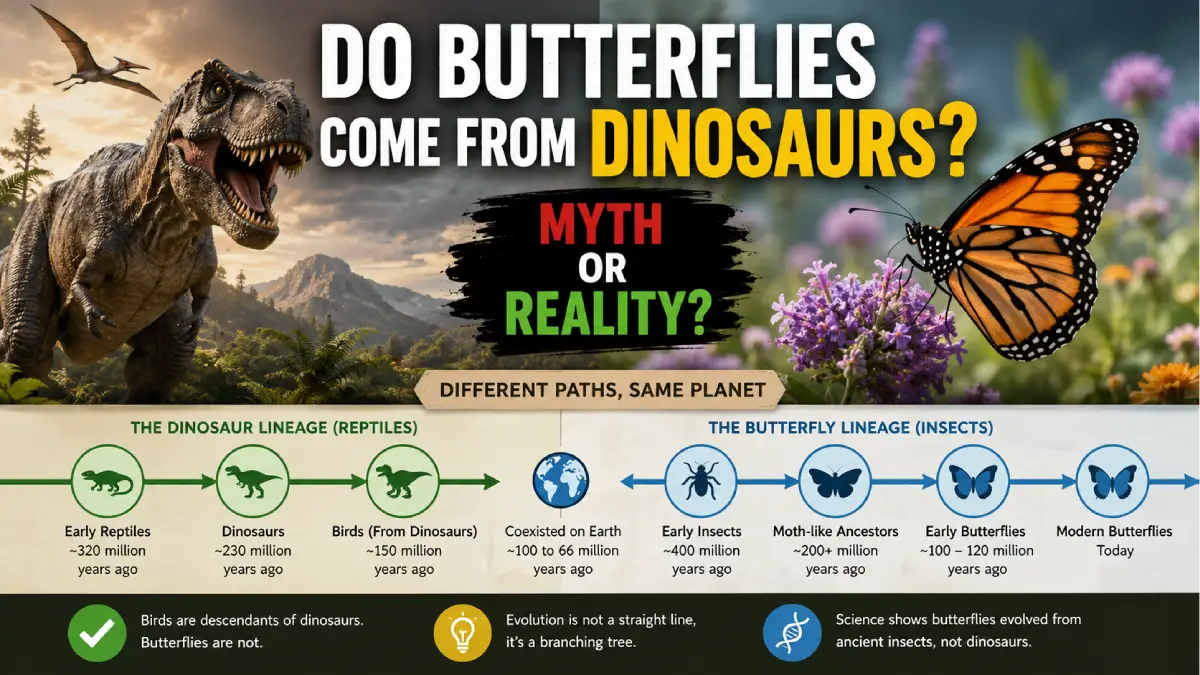
The notion that “butterflies evolved from dinosaurs” has seen a surge in popularity online, with various posts & videos surfacing and implying that the brightly colored butterflies we see flitting about may have descended from those prehistoric giants. It is an intriguing idea, but the technical answer is not quite that straightforward. “While both dinosaurs and butterflies existed over vast geological time scales, they belong to separate major evolutionary lines of life.
Dinosaurs were craniate faunae from the reptilian family.
Butterflies are in the air insects from the order Lepidopterans. If we appearance far enough back – many millions of years ago – butterflies & dinosaurs do share a common ancestor, but butterflies are not descendants of dinosaurs,” described National Geographic.
In this guide, you’ll discover:
- Where butterflies really came from
- When butterflies first appeared
- Whether dinosaurs and butterflies lived at the same time
- What fossils reveal
- Why this myth became popular
- The latest scientific understanding of butterfly evolution
Table of Contents
Definition Snippet
Mothlike persons evolve into butterflies. Millions of the years have accepted since then, and today we have what are called Butterflies. Even some of the early butterflies co-existed with the dinosaurs. But the Butterflies do not come from the dinosaurs.
What Are Butterflies?
Butterflies are flying insects which are classified within the technical order called as Lepidoptera, of which the moths are also members.
Their defining features include:
- Four scaled wings
- Six legs
- Compound eyes
- Complete metamorphosis
- Long feeding tube called a proboscis
Currently, extra than 18,000 species of butterflies have been recognized across the globe; more species still live among them.
Butterflies play important ecological roles by:
- Pollinating flowers
- Supporting food chains
- Indicating ecosystem health
- Contributing to biodiversity
What Were Dinosaurs?
Dinosaurs were reptilians that dominated terrestrial bionetworks for approximately 165 million years.
They appeared around 230 million years ago during the Triassic Period.
Examples include:
- Tyrannosaurus rex
- Triceratops
- Stegosaurus
- Velociraptor
Not all dinosaurs became extinct.
One extraordinary scientific discovery is that modern birds changed from certain theropod dinosaurs.
This often causes misperception because people hear:
“Birds are living dinosaurs.”
That statement is reinforced by extensive fossil and genetic evidence.
However, butterflies are an entirely different group.
Did Butterflies Live During the Dinosaur Age?
Interestingly, yes—but only during the later part of the dinosaur era.
Scientists believe early butterflies appeared approximately 100–120 million years ago, during the Cretaceous Period.
This means:
- Dinosaurs already existed.
- Flowering plants were beginning to diversify.
- Early butterflies evolved alongside changing ecosystems.
So although butterflies and dinosaurs may have shared parts of Earth’s history, this does not mean one evolved from the other.
Timeline of Evolution
| Event | Approximate Age |
| First insects appear | 400 million years ago |
| First dinosaurs appear | 230 million years ago |
| Flowering plants diversify | 140–125 million years ago |
| Early butterflies evolve | 100–120 million years ago |
| Dinosaur extinction | 66 million years ago |
| Modern butterflies diversify | After dinosaur extinction |
This timeline clearly shows that butterflies emerged while dinosaurs still existed but followed their own evolutionary path.
Why Do People Think Butterflies Came from Dinosaurs?
Several factors contribute to this misconception.
1. Birds Are Descendants of Dinosaurs
Scientific research has confirmed that birds evolved from certain theropod dinosaurs.
People sometimes mistakenly extend this idea to other flying animals, including butterflies.
However, birds are vertebrates, while butterflies are insects.
These groups diverged much earlier in evolutionary history.
2. Social Media Simplifies Science
Short videos and viral posts often condense complex scientific topics into catchy statements.
While this attracts attention, it can blur important distinctions between related concepts.
For example:
- “Birds came from dinosaurs.” ✔
- “Butterflies came from dinosaurs.” ✘
Understanding the difference helps prevent the spread of misinformation.
3. Shared Time Period
Another source of confusion is that butterflies and dinosaurs coexisted during part of the Cretaceous Period.
Living at the same time does not imply a direct evolutionary relationship.
Many unrelated organisms shared ancient ecosystems.
For example:
- crocodiles
- turtles
- insects
- mammals
- flowering plants
Each evolved along separate branches of life’s history.
How Did Butterflies Actually Evolve?
Scientists believe butterflies evolved from moth-like ancestors.
The transition likely involved gradual adaptations such as:
- daytime activity
- brighter wing colours
- specialised relationships with flowering plants
- improved visual communication
- diverse feeding strategies
As flowering plants spread across the planet, butterflies diversified into thousands of species adapted to different environments and food sources.
This evolutionary partnership between butterflies and flowering plants is one of nature’s most remarkable examples of co-evolution.
Fossil Evidence: What Scientists Have Found
One of the strongest ways to understand the origins of butterflies is through fossil evidence. Although butterfly fossils are relatively rare because insects have delicate bodies, researchers have discovered important specimens preserved in amber and ancient sedimentary rocks.
These discoveries help scientists estimate when butterflies first evolved and how they diversified over time.
Some fossil evidence suggests that early butterfly ancestors appeared during the Cretaceous Period, around 100–120 million years ago. This was a time when flowering plants were becoming more common, creating new food sources and habitats for pollinating insects.
Rather than showing butterflies evolving from dinosaurs, fossils demonstrate that butterflies developed from earlier insect ancestors through gradual evolutionary changes.
How Scientists Study Butterfly Evolution
Researchers combine several scientific methods to understand butterfly history.
Fossil Analysis
Fossils provide physical evidence of ancient insects, allowing scientists to compare body structures with modern butterflies.
DNA Studies
Modern genetic analysis helps scientists estimate when different butterfly groups separated from their common ancestors.
Comparative Anatomy
Scientists compare:
- wing structure
- mouthparts
- antennae
- reproductive organs
- life cycles
These comparisons reveal relationships among insects while distinguishing them from reptiles such as dinosaurs.
Geological Dating
The age of surrounding rock layers helps estimate when ancient butterfly fossils lived.
Combining these methods provides a much clearer picture than relying on fossils alone.
Butterfly Evolution Explained
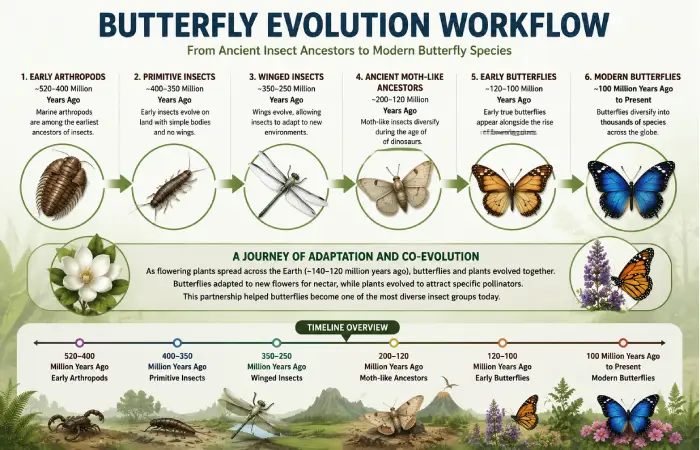
Butterflies belong to a long evolutionary lineage of insects that began hundreds of millions of years ago.
A simplified evolutionary pathway looks like this:
Early Arthropods
│
▼
Primitive Insects
│
▼
Winged Insects
│
▼
Ancient Moth-like Ancestors
│
▼
Early Butterflies
│
▼
Modern Butterfly Species
Notice that dinosaurs are not part of this evolutionary pathway.
Instead, dinosaurs followed an entirely different branch:
Early Reptiles
│
▼
Dinosaurs
│
▼
Birds
Although both butterflies and dinosaurs existed during part of Earth’s history, they evolved independently.
Butterfly Life Cycle Workflow
Understanding the butterfly life cycle also highlights how different butterflies are from reptiles.
Step 1 – Egg
Female butterflies lay eggs on suitable host plants.
↓
Step 2 – Caterpillar (Larva)
The caterpillar feeds continuously to support rapid growth.
↓
Step 3 – Chrysalis (Pupa)
Inside the chrysalis, the caterpillar undergoes complete metamorphosis, reorganising its body into an adult butterfly.
↓
Step 4 – Adult Butterfly
The adult emerges, expands its wings, feeds on nectar, reproduces, and begins the cycle again.
This remarkable process is unique to insects with complete metamorphosis and has no equivalent in dinosaur development. For more related articles visit our website
Comparison Table: Butterflies vs Dinosaurs
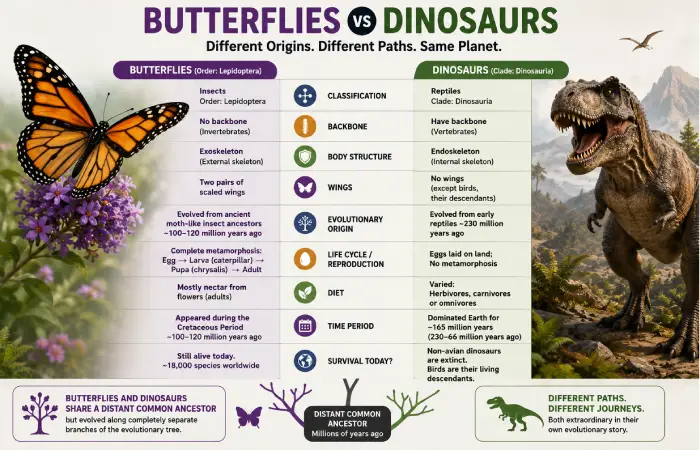
| Feature | Butterflies | Dinosaurs |
| Animal Group | Insects | Reptiles |
| Backbone | No | Yes |
| Skeleton | External (exoskeleton) | Internal skeleton |
| Wings | Scaled wings | Only some dinosaur descendants (birds) have feathered wings |
| Reproduction | Eggs with metamorphosis | Eggs without metamorphosis |
| Scientific Order | Lepidoptera | Dinosauria |
| Still Living? | Yes | Non-avian dinosaurs are extinct; birds are living descendants |
| Direct Relationship | None | Birds evolved from certain dinosaurs |
From this comparison it is obvious that butterfly and dinosaur are from two separate species.
Myth vs Reality
| Myth | Reality |
| Butterflies evolved from dinosaurs. | False. Butterflies evolved from ancient insect ancestors. |
| Butterflies lived alongside dinosaurs. | True. Some early butterflies appeared during the late Cretaceous Period. |
| Birds evolved from dinosaurs. | True. Modern birds are descendants of certain theropod dinosaurs. |
| Butterflies are closely related to reptiles. | False. Butterflies are insects and are much more distantly related. |
Why Flowering Plants Were Important
One of the biggest influences on butterfly evolution was the spread of flowering plants.
As flowering plants diversified:
- nectar became available
- new habitats formed
- pollination opportunities increased
- specialised relationships developed between plants and insects
Scientists believe this co-evolution helped drive the rapid diversification of butterflies into thousands of species found today.
Expectations Management
So here’s my warning – with regards to what you read about prehistoric animals and the theory of evolution you should expect the truth not the hype.
Scientific information changes as new evidence develops available, but current evidence strongly supports that:
- Butterflies are insects.
- Dinosaurs were reptiles.
- Birds evolved from certain dinosaurs.
- Butterflies did not evolve from dinosaurs.
Future fossil discoveries will then be tested against scientific methods instead of hypothesis- If further fossil discoveries shed light on butterflies’ early evolution.
Key Facts at a Glance
- Butterflies belong to the insect order Lepidoptera.
- Dinosaurs belonged to the reptile group Dinosauria.
- Early butterflies likely appeared around 100–120 million years ago.
- Dinosaurs first seemed roughly 230 million years ago.
- Butterflies and dinosaurs overlapped in time during part of the Cretaceous Period.
- Modern birds—not butterflies—are the living offspring of certain dinosaurs.
Frequently Asked Questions (FAQs)
- Do butterflies come from dinosaurs?
No Butterflies did not slope from vestiges. Butterflies are derived from an ancient ancestor of insects, & the dinosaurs were members of a group called reptiles. They lived during some shares of earth’s history but took divergent evolutionary branches.
- Did butterflies live at the same time as dinosaurs?
Yep. Technical evidence has chosen that the earliest butterflies evolved around the Late Cretaceous, so there’s a chance that some of these delicate beings fluttered alongside dinosaurs before their mass extinction ~66 million years ago.
- Why do people believe butterflies came from dinosaurs?
Common Misconception 3. “Birds are modern day dinosaurs.” You might hear this from kids in school since birds descended from dinosaurs, but that does not extend to every flying animal out there – you won’t see dinosaurs in butterfly form.
- What are butterflies descended from?
Ancient moths like insects finally evolved into butterflies over masses of years. The evolution of butterflies depends on the diversification of flowers.
- Are birds the only living dinosaurs?
Currently, we believe that modern birds are actually the living descendants of a type of theropod dinosaurs. Nonavian dinosaurs died out 66 million years ago.
Conclusion
Butterfly & Dinosaurs, It is the kind of thrilling scientific idea that gets a little lost or misrepresented when it exteriors on the Internet – “Are butterflies related to dinosaurs?” Now, it’s true butterflies and dinosaurs were around at the same time – the period is called the Cretaceous — however, they are completely unrelated evolutionary journeys. The first fears were to develop in primitive insect relatives and they started fluttering along with early blooming flowers, and then the dinosaurs were branch after branch of reptilian lineage to rule the earth’s land creatures for a hundred million years or more. Of course, these days, some of the ancient dinosaurs do have offspring, living on into the present time (they’re called birds), but butterflies didn’t evolve to have living offspring. When you retrace the particular flight of story that butterflies have to tell us about using evidence such as fossils, DNA and biology, we can begin to understand the scientific process by differentiating between theory and evidence.