
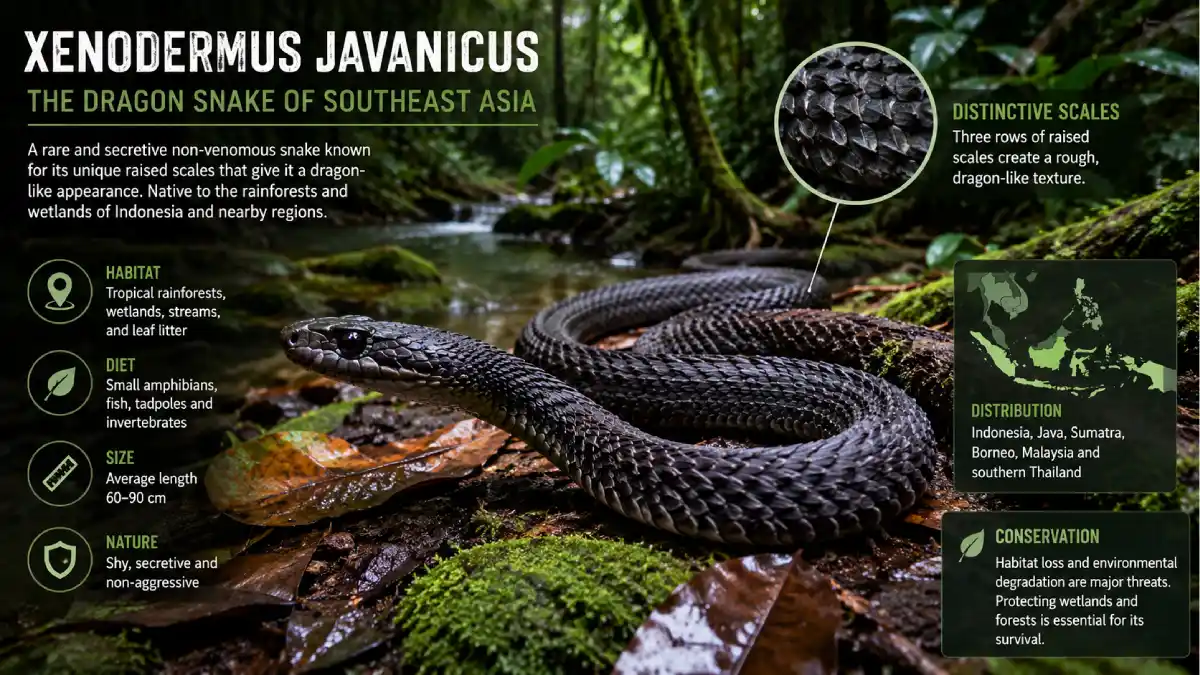
Indonesia has some of the most fantastic reptiles on earth and none more unusual than Xenodermus javanicus. The dragon snake, a rare species that has garnered intrigue due to its appearance, enigmatic behavior and the fact that there have not been many studies performed on this animal. Not a commonly found snake such as some, Xenodermus javanicus looks very unusual due to the presence of ridge-like scales that appear like armor and look like those of a dragon.
Despite its unique and rather frightening appearance many factors regarding the life of this snake and how long the population will survive in the wild remain a mystery.
In this educational article, we will discover all that there is to know about the xenodermus javanicus, where they are from, what they eat and why this amazing serpent is one that needs defensive.
Table of Contents
Definition
The Xenodermus javanicus is a snake in the genus Xenodermus and is the only species in the genus that has ever been described. It is an member of the family Xenodermidae, native to parts of Indonesia, Malaysia, and Thailand, as well as neighboring parts of Southeast Asia. Xenodermus javanicus is noted for its unusual scaly hide, as opposed to its disposition.
What is Xenodermus javanicus?
The dragon snake, a small-medium size non-venomous snake, spends a lot of time undercover in the moist undergrowth of woods, marshland, and streams.
Quite the conflicting of the flashy tropical snake varieties, its markings are black to dark grey, & are scattered by raised, uneven scales crossways its body.
Its distinctive skin feel makes it appear to look like a tiny, fierce dragon! While dragon snakes have gained important popularity within the reptilian loving community, they are still rarely found in captivity as they do not cope well deprived of extremely particular ecological setup.
Scientific Classification
| Classification | Details |
| Scientific Name | Xenodermus javanicus |
| Common Name | Dragon Snake |
| Kingdom | Animalia |
| Phylum | Chordata |
| Class | Reptilia |
| Order | Squamata |
| Family | Xenodermidae |
| Venomous | No |
| Native Region | Indonesia and Southeast Asia |
Physical Characteristics of Xenodermus javanicus
The dragon snake has several distinctive features.
Appearance
- Dark grey or black body
- Three rows of raised scales
- Slender build
- Long tail
- Small head
- Matte rather than glossy scales
Average Size
Most adult individuals grow between:
- 60–90 cm in length
- Relatively lightweight body
Because sightings are uncommon, exact size variation is still being studied.
Habitat and Distribution
Where is Xenodermus javanicus Found?
Its natural range includes:
- Indonesia
- Java
- Sumatra
- Borneo
- Peninsular Malaysia
- Southern Thailand
It prefers humid environments with access to shallow water.
Common habitats include:
- Tropical rainforests
- Wetlands
- Swamps
- Forest streams
- Leaf litter
- Moss-covered ground
These habitats provide shelter, food and stable humidity.
Behaviour and Lifestyle
Xenodermus javanicus is considered shy and secretive.
Researchers believe it spends much of its time:
- Hidden beneath leaves
- Near streams
- Active during cooler periods
- Avoiding predators through camouflage
It is not regarded as an aggressive species and generally avoids confrontation when disturbed.
Diet
The exact diet in the wild has not been fully documented, but observations suggest it feeds on small animals such as:
- Frogs
- Tadpoles
- Small fish
- Amphibians
- Occasionally small invertebrates
Its feeding habits remain an active area of scientific study.
Workflow: How Researchers Study Xenodermus javanicus
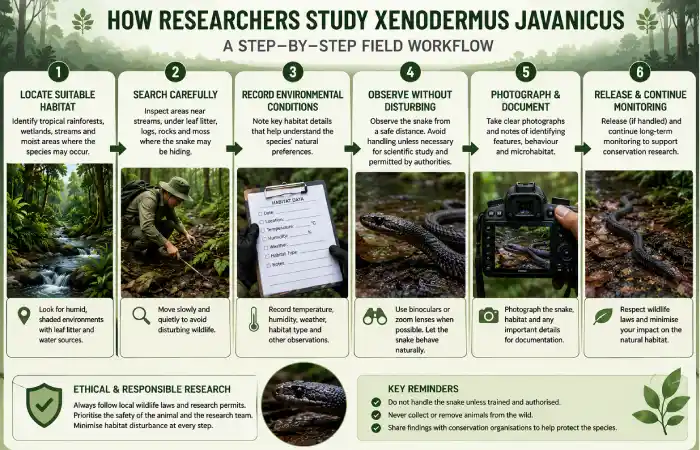
Locate suitable wet forest habitat
↓
Search near streams and leaf litter
↓
Record environmental conditions
↓
Observe without disturbing the animal
↓
Photograph and document physical features
↓
Release or continue field observation in accordance with wildlife regulations
This workflow helps researchers collect valuable ecological data while minimising disturbance to the species. For more related articles visit our website
Is Xenodermus javanicus Dangerous?
For most people, the answer is no.
Current scientific knowledge indicates that Xenodermus javanicus is considered non-venomous and is not known for aggressive behaviour.
However, as with all wild snakes:
- Do not attempt to handle them.
- Observe from a safe distance.
- Respect local wildlife laws.
- Avoid disturbing natural habitats.
Comparison: Xenodermus javanicus vs Common Garden Snake
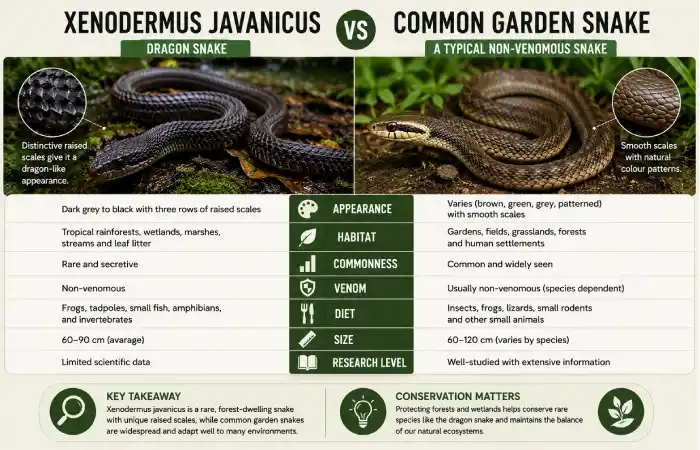
| Feature | Xenodermus javanicus | Common Garden Snake |
| Appearance | Raised dragon-like scales | Smooth scales |
| Habitat | Tropical forests and wetlands | Gardens, fields and forests |
| Rarity | Rare | Common |
| Venom | Non-venomous | Usually non-venomous (species dependent) |
| Research | Limited | Extensive |
| Visibility | Rarely seen | Frequently encountered |
Conservation Status
Although Xenodermus javanicus is not among the world’s best-known endangered reptiles, habitat loss remains a concern.
Threats include:
- Deforestation
- Wetland destruction
- Illegal wildlife collection
- Environmental degradation
Protecting tropical forests benefits not only this species but many other reptiles, amphibians and mammals.
Expectations Management
Many online articles describe the dragon snake as extremely rare or impossible to keep in captivity. While it is certainly uncommon, readers should keep realistic expectations.
Current knowledge has limitations because:
- Scientific research is relatively limited.
- Wild observations are infrequent.
- Population estimates remain uncertain.
- Behaviour varies between habitats.
As new research becomes available, our understanding of this species may improve.
Interesting Facts
- It is the only recognised species in its genus.
- Its raised scales inspired the nickname “dragon snake.”
- It prefers humid tropical environments.
- It is primarily known from Southeast Asia.
- Scientists continue studying its ecology and behaviour.
Frequently Asked Questions
What is Xenodermus javanicus?
Xenodermus javanicus is a rare non-venomous snake native to Indonesia and other parts of Southeast Asia. It is commonly known as the dragon snake because of its distinctive raised scales.
Is Xenodermus javanicus venomous?
Current evidence indicates that it is considered non-venomous.
Where does Xenodermus javanicus live?
It inhabits tropical forests, wetlands, marshes and streamside environments with high humidity.
Why is Xenodermus javanicus called the dragon snake?
Its unusual rows of raised scales give it a rough, dragon-like appearance.
Can Xenodermus be kept as a pet?
Although it occasionally appears in the exotic reptile trade, it is regarded as a specialised species with complex husbandry requirements. It is generally unsuitable for beginners, and local wildlife regulations should always be followed.
Conclusion
The Xenodermus javanicus remains one of Indonesia’s most captivating reptiles. Its unusual appearance, elusiveness, & alternated nature maintain it as a significant topic in the field of wildlife science. Even so, research continues to expand our understanding & designates this dragon snake is nonvenomous and plays an important role in bionetworks throughout Southeast Asia. Supporting for conservation efforts and using science to inform conservation choices will further aid protection for this interesting snake.